
Prosaic Times: Your business is a dynamic system
Use graphs and agents to model business domains and dynamic systems

Some thoughtful young men encouraged me to read Smart Brevity, given that , er, issues of Prosaic Times run to 3,000 words. Some of my colleagues say that I write more quickly than they can read. I may have suggested, in return, that they might learn to read more quickly, but the historical record is unclear here.
The book includes much goodness about structure, specificity, avoidance of modifiers and use of active voice. But the authors are journalists. They must capture eyeballs, not move organizations -- limiting the applicability of their advice. Though I took some of it -- you will see more bullet points in this issue!
The issue of Prosaic Times proposes that we must look at business domains as dynamic systems that include technology and humans -- and investigates what we must do to shape both the technical and the human parts of the system.
The main argument discusses how we use a combination of graphs and agents to address business entropy, how agents and humans can collaborate to build necessary ontologies and how we can influence the human elements of the system at scale.
The wire section includes The Strategists, which traces how idiosyncratic decisions by Churchill, Stalin, Hitler, Roosevelt and Mussolini, operating in the systems around them shaped the course of the war.
The main argument: using systems thinking to elevate AI from tactics to strategy
The takeaway
AI becomes strategic when you move beyond automating tactics to modeling and steering business domains as dynamic systems — and shaping the behavior of both the technology and the people within them.
Exploiting technology to solve business problems requires navigating entropy. Your business has a 🔀 bewildering 🔢 array of products, service offerings, organizations, locations, ⚠️ risks, ⚙️ physical assets and vendors. Developing an 📈 accretive 🌎 strategy and building the systems to support it.
What you do about this: Make sure you and your 🧑💻 team understand the what drives entropy in the businesses you support.Traditional Machine learning was tactical. It managed complexity by focusing on less complex tasks. It worked best in domains with good quantitative 🗄️ data — process 🏭 manufacturing, ☎️ call center queues, B2C pricing -- and in making discrete, well-understood ⚖️ decisions.
What you do about this: Communicate to your peers and your team and how much more ambitious you can now be in applying AI for 🌍 strategic advantageGraphs and 🤖 agents together are strategic. Graphs plus agents allow you to model a 🏢 business domain (or an entire business) as a dynamic system that includes both 💻technology and the 🙋people who use it. AI can help you evolve your business model, rather than just tune your operations -- if you think of business domains as dynamic systems that include 🙋 humans and 🤖 agents.
What you do about this: Identify the first 🏢 business domain you might want to turn into a graph by building semantic layer there -- and the set of 🌍 strategic levers the leadership team might want to pull thereTeam cyborg will create ontologies and populate graphs No, ontologies are not easy to create -- neither 🧑💻 human nor 🤖 agents will do this alone. Together they can transit an OODA 🔁 loop to create an ontology specific enough to be meaningful and simple enough to maintain.
What you do about this: As the ability to create semantic 🧱 layers will be a source of strategic advantage, invest in both the human capabilities and the tooling required.Aspire to victory in the cognitive domain. Building and exploiting technology for 🌍 strategic advantage depends on influencing the 🙋humans who use and create it. Education will be more important than persuasion -- everybody from front-line 🧑💻 technologists to customers and 🧑💼 senior executives will need to think in terms of business domains as dynamic systems.
What you do about it: Don’t just inform, or even just persuade. Teach yourself and your team how to educate.Build the 💻 technology to help your 🙋humans move other humans. Our current technology model to support humans in influencing other humans in corporate environments (i.e. knowledge work) is a 🔥 hellscape of 😓 toil and 😵💫 frustration. Making it easier to shape the human environment is no less important than making it easier to evolve the technology environment!
What you do about it: Put technology in place to support ⚾ Moneyball for 📘 written communications and DocOps (e.g. composable documents).
1. Exploiting technology to solve business problems requires navigating entropy
Back when I thought a dress shirt cost 50 dollars, I led the process integration work stream for a multi-year, multi-hundred million dollar billing system replacement for a telecom carrier’s medium-sized enterprise business. It frustrated me. How hard could this all be? You grabbed the call detail record (CDR) from the traffic system, used the Uniform Service Order Code (USOC) to determine rack billing rate and looked up the service plan and accompanying discount based on the Billing Telephone Number (BTN).
Tired of listening to me ask this question, one member of the billing team brought me to a big conference room, with spreadsheet printouts stacked several feet high on every surface and much of the floor.
“You want to know why this is so time-consuming and tough?” she asked, “Because there are so many service plans and they are so complicated that they fill a conference room when we print them out.” [1] How do you formulate an accretive business strategy -- and build the supporting system -- in the face of a seemingly infinite number of service offerings that continue to change quickly?
More than anything else, using technology to solve business problems requires navigating complexity -- in products, service offerings, organizations, locations, risks, physical assets and vendors. All of the business domains you support -- and the enterprise technology business domain you run -- are intricate dynamic systems in which each part impacts other parts.
What you do about this: Make sure you and your 🧑💻 team understand what drives complexity in the businesses you support. What do business leaders understand? What befuddles them? What complexity enhances your customer value proposition? What complexity derives from happenstance or internal politics?
2. Traditional machine learning was tactical
When I was but a pup in a cheap suit, a wizened old hand told me that the best professional can transition between jetliner-eye and lawnmower-eye view. John Lewis Gaddis made the same point in On Grand Strategy, evoking Isaiah Berlin, evoking Aesop. Successful strategies intermediate across time and space between conceptual aspirations and immediate actions. Traditional machine learning operated at one end of the spectrum. It took the lawnmower-eye view, and it only mowed part of the yard. It managed complexity by attacking (very successfully!) less complex problems:
It worked best in domains with good quantitative data — process manufacturing, call center queues, B2C pricing -- and in making discrete, well-understood decisions
It optimized parts of the advanced economy that already ran pretty efficiently two decades ago.
It provided very little for the messy, inefficient reality of knowledge work, e.g. professional services, and the labyrinth of B2B, creating a paradox in advanced economies: highly optimized factories and chaotic offices.
Traditional machine learning excels at determining how much you should charge a 55-year old man who writes slide decks for a living [2] to insure his station wagon, but can’t tell you whether you want to stay in the consumer auto insurance business.
What you do about this: Communicate to your peers and your team about how much more ambitious you can now be in applying AI for strategic advantage. What are the things that they couldn’t do even two years ago that would be exciting? What are the business domains and processes where you have not tried to apply AI?
3. Graphs and agents together provide strategic advantage
Last month Jaya Gupta from Foundation Capital and Player Zero CEO Animesh Koratana posted a very helpful article about context graphs and decision traces. They argued that collecting “decision traces” (the case law of business decisions) would allow agents to make inferences about, for example, when to offer a discount that out-performed any set of rules you could formulate. Quite so.
But they could have gone further. Graphs plus agents allow you to model a business domain (or an entire business) as a dynamic system that spans both technology and the people who use it. Here’s an example of thinking about enterprise technology ROI as a graph
Business driven investment adjusted for value leakage (e.g. investing in the wrong functionality) and deadweight loss (inefficient engineering) drives EDITDA lift [3] from technology investment
Multiple levers (e.g rebuilding technology platforms, redesign talent model) improve engineering productivity
Improved engineering productivity allows for more efficient tech debt reduction, which both reduces run costs and further improves engineering productivity
Reduced run costs increases funding available for business driven investment, driving up EBITDA lift
Improved engineering productivity reduces deadweight loss and produces more ROI for each dollar invested in business functionality
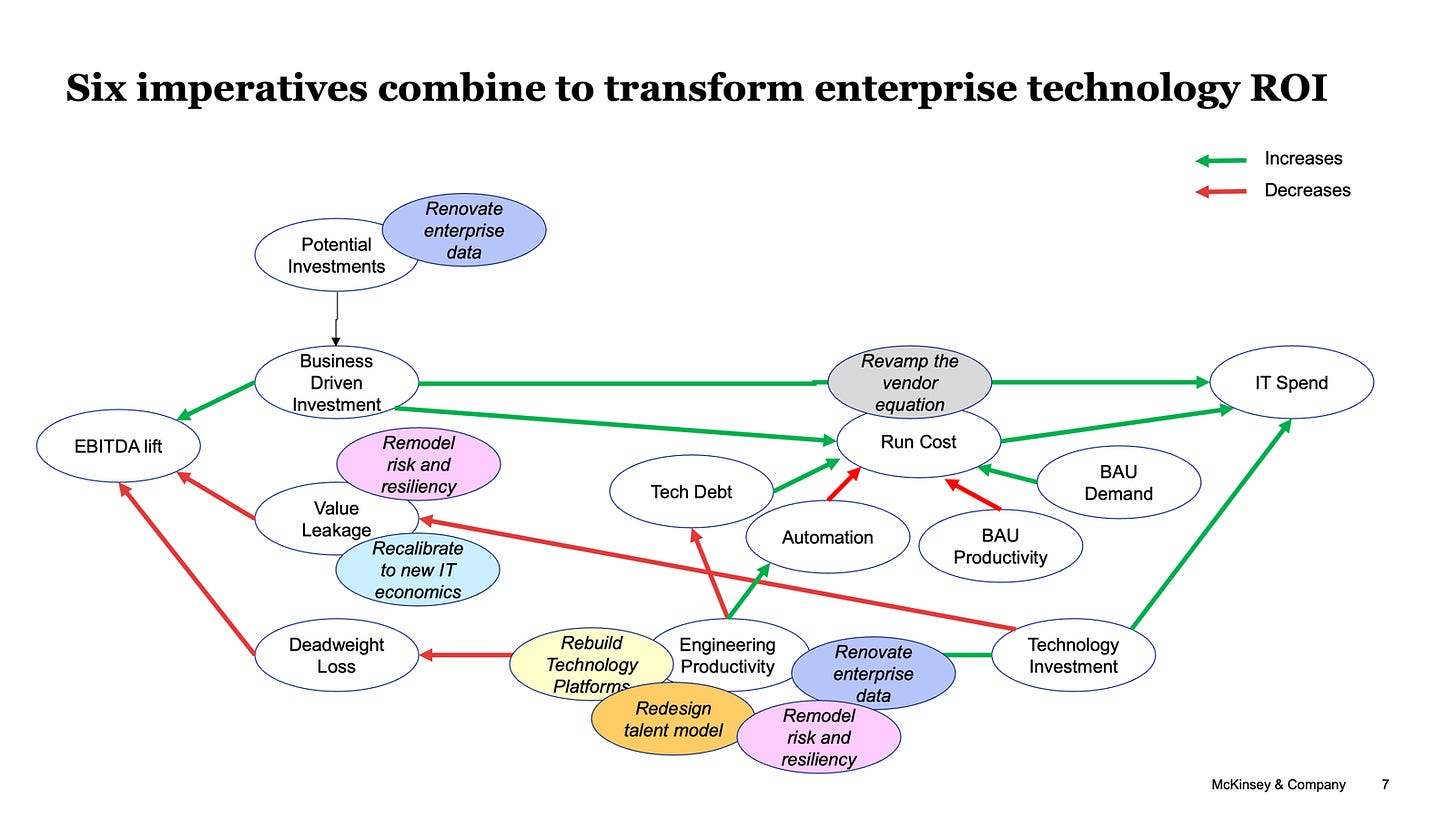
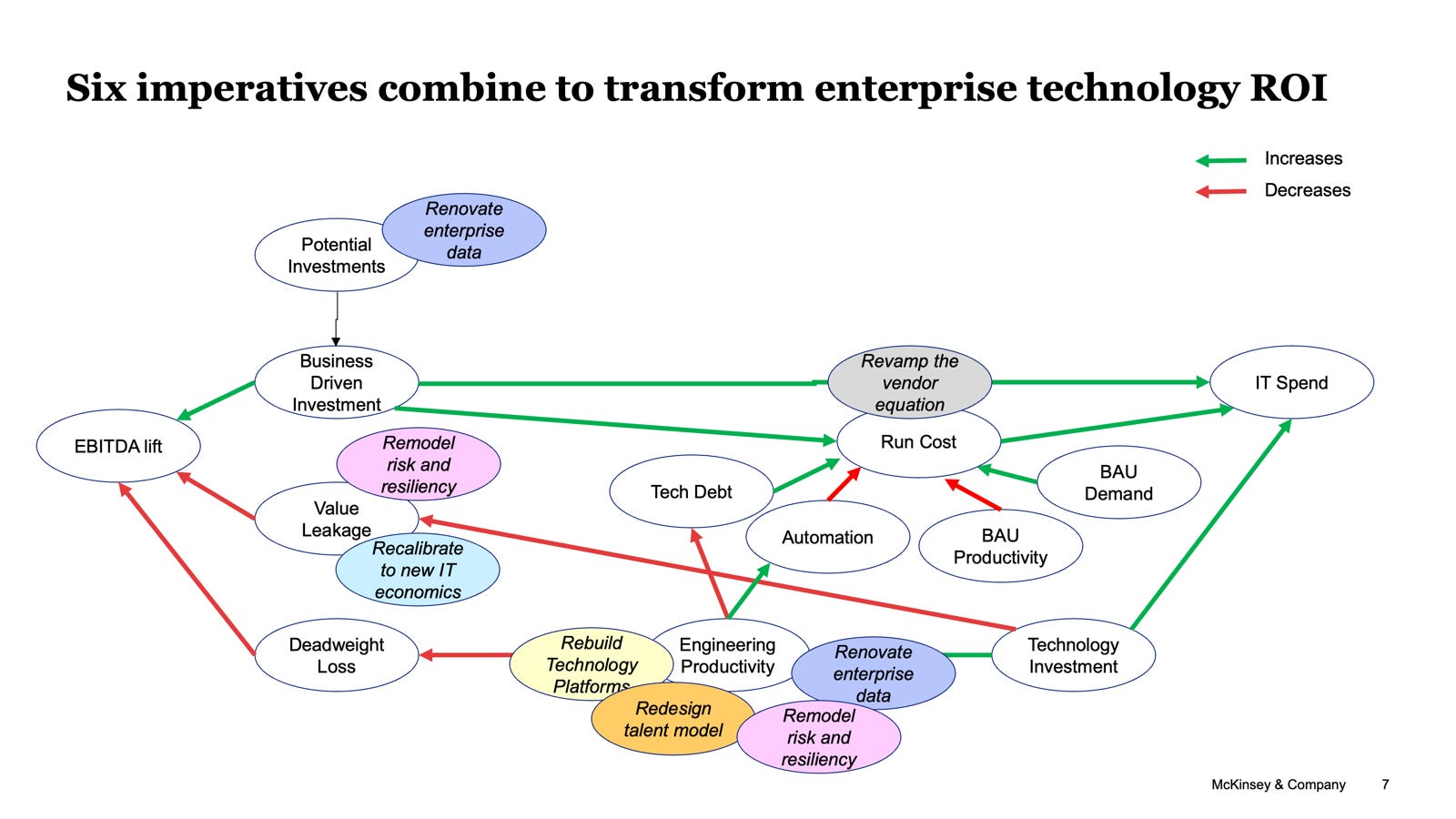
You can see how human and digitized actions interact to drive ROI -- and how targeted investments in the enterprise technology “system” produces better-than-linear returns in EBITDA lift.
Looking at your business or business domain as a graph provides a strategic as well as tactical insight.
Not just whether you should invest in a given system, but what your model for enterprise technology should be.
Not just what type of discount to offer a 55-year old station wagoner-driver [4] a discount, but whether increasing scale will allow to stay in the consumer auto insurance business at all. Agents parse the data and map the patterns that indicate the opportunity. The human applies the creativity and judgement required to get there, given decades of political context that you can’t shove into a prompt.
God of Prompt shows top labs use a graph to diagnose performance drivers for a business domain
The graph becomes a way of aggregating Collaborative Intelligence across a system.
What you do about this: Identify the first business domain you might want to turn into a graph by building semantic layer there -- and the set of strategic levers the leadership team might want to pull there. Who are the business leaders who will get the idea that their business domain is a dynamic system?
4. Team cyborg will create ontologies and populate graphs
To create and exploit a semantic layer that defines the elements in a domain and how they relate to one another
The semantic layer will include multiple ontologies, not just a “business digital twin,” but also ontologies for analyses you will perform, best practices you might apply, decisions you might make and improvement initiatives you might launch. Business domains are not simple.
Many, if not most, ontology efforts have collapsed under their own weight. The semantic web of the 2000s disappeared in a hurricane of frustration and tears.
They were either too abstract to be meaningful, too generic to have any impact or too complicated to maintain. Using technology to solve business problems requires handling complexity.
Some commentators have asked how long, for example, implementation barriers will delay adoption of context graphs.
Remember: (per Luttwak) strategic advantage derives from doing things that are hard, not things that easy.
Helpful ontology design patterns are emerging.
Height matters. Companies will make distinctions between most abstract upper ontologies and more specific lower ontologies.
Academic research pushes us to simpler and more generally applicable ontologies than we created in the past.
We can learn from the lessons of object-orientation -- as we move from industry standard to company specific or upper to lower ontologies we can leverage the principles of inheritance and deformation.
What you do about this: As the ability to create semantic layers will be a source of strategic advantage, invest in both the human capabilities and the tooling required. How many data scientists in your organization can build an ontology? How many would try to do it just on whiteboard?
But the core issue is the collaboration between human and machine -- cyborgs will defeat artisans or androids.
One side argues that you ensure currency by inferring the ontology from operational data, the other that you should ground your ontology in a rigorous, industry-standard schema.
Do you believe in artisans, who have honed their craft over decades, or androids who will do the work for us?
Team cyborg will win -- to my experience ontology creation implies a dialectic between expert and machine.
GenAI accelerates ontology design and graph creation. The individual and the machine combine to traverse what John Boyd described as an OODA loop. The model collects patterns. The expert develops a hypothesis. The model helps structure it. The expert probes for blind spots. The model ensures consistent implementation. Together they traverse a cycle toward an effective semantic layer.
5. Aspire to victory in the cognitive domain
I hate the term change management, associating it with lunch-and-learn sessions about the new expense reporting system or personal time off policy. That’s unfair. Change management is a prosaic term for shaping how people think and act -- for victory in the cognitive domain.
Business domains are dynamic systems that combine humans and technology. Many of the actors in these systems -- vendors, customers, regulators -- will be outside of your corporate control.
Creating a semantic layer requires a collaboration between human and model.
So building and exploiting technology for strategic advantage requires influencing the humans who use and create it.
Rhetoric is a political and educational technology that allows you to influence human participants in your system at scale and over time. Use it as a weapon.
Don’t bother using rhetoric just to inform -- YAML is probably better. Use rhetoric to persuade -- and more importantly -- to educate.
Containerized shipping made logistics cheap. GenAI (which is an exceptional parser) will make facts easier, or at least easier. Opinions will always be cheap. You change what humans think by using the classic tools of rhetoric to integrate facts into an argument.
But changing what people think only helps when we know what we want them to do ahead of time.
We can’t anticipate every circumstance, so we can’t prescribe the actions we want people to take. [5] We want to help our colleagues learn how to use a graph to think about their business domain differently, not just that they should charge 55-year-old station wagon drivers more for auto insurance.
Education is the highest endeavor in the cognitive domain. You need people not only pay attention to you, but also metabolize what you say -- requiring not only clear statements, but also metaphors, anecdotes and parables. [6]
What you do about it: Don’t just inform, or even just persuade. Teach yourself and your team how to educate. Where do you need to shape behavior and change the way people think? Who on your team is a compelling educator?
6. Build the technology to reduce the pain for your humans in moving other humans
That’s great we need to shape human behaviot, but our current technology model to do that in corporate environments (i.e. knowledge work) is a hellscape of toil and frustration. It could be a lot better.
The process for things like RFP responses and strategy documents lies between “Ask Joe to send you the product quality analysis we used on the OldCo deal” and “Have Sally read through this before you send it to the CFO -- she knows what he likes.”
Four capabilities might move the needle here: systematic capture of relevant performance metrics, curation of atomic content, programmatic document assembly and linguistic analysis)
Imagine a world where you can capture propositions and collections of data in a graph and assemble them into a training document, a regulatory submission or an RFP response based on context
This helps with content composition (important!) but also argument or narrative composition (maybe more important!)
To Gaddis’ point about strategy mediating between the conceptual and the tactical, reducing the pain in “change management” might require some very prosaic but far-reaching technology changes.
Slide presentations don’t lend themselves to composable documents, not because bullet points are bad [7], but because of pagination
Pagination (determining what goes on what page) is a pain in the neck. When constructing a slide deck you have to ask “When on the page should this piece of text go?” Or “Can I jam this all on one slide or do I have to create an additional one?” [8]
It happens automatically in vertical document, you just insert the next piece of text after the last piece of text.
Pagination is also a pain in the neck for Large Language Models. Sometimes the model (or its interface) will simply tell you that it cannot create a slide out of the output it just provided. [9] Yes, some products have had more success constructing slides, but it’s structurally difficult. Why bother?
Of course it’s not as simple as that -- path dependency and technology innovation may save the slide deck. [10]
We may want to move from proprietary, binary file formats to text-based formats in building DocOps.
How wonderful it is to create a database in Obsidian and manipulate it with Cursor! Try doing that with a tool that uses a proprietary file format.
Some knowledge management tools treat each paragraph as an object (rather than just each document) as an object -- and a couple like Obsidian use plain text (if not standard markdown) to do it.
Using a text based standard brings us much closer a “document-as-code” -- and allows companies to assemble and build multiple capabilities into a document toolchain.
Maybe plain text productivity will become a catch phrase?
What you do about it: Put technology in place to support Moneyball for written communications and DocOps (e.g. composable documents). Where are the places that your team or the businesses you support need to shape the environment? What are the materials that would be the proof-of-value for composable documents and DocOps?
The wire section
The Strategists -- Churchill, Stalin, Roosevelt, Mussolini and Hitler: How War Made Them and How They Made War, Philips Payson O’Brien. I used to say that no book approaches Richard Overy’s Why the Allies Won in terms of analytic history of the Second World War. Then O’Brien published How the War Was Won, in which he argued the Allies’ grand strategic decision to focus on building planes and ships for the “air-sea super-battlefield ” shaped the course of the war and resulted in the Axis’ crushing defeat. In The Strategists, O’Brien turns from the machines to the men in the system and examines why the warlords made the decisions they did.
The Rise and Fall of Visual Basic. We should remember our history, even our kinda embarrassing history. At least Visual Basic is (was) better than vibe coding. Of course, every reference Visual Basic reminds me of this book. I think I had to buy a second copy because the first one I had feel apart from constant use.
Footprints in the Sand, I suppose this is the riposte to those like me who think that models excel at parsing and predicting, rather than reasoning.
Footnotes
[1] Why did they print out all the service plans and put them in a conference room? It was the 1990s. People listened to the spice girls. They went to bars that only served champagne. And they printed out tons of documents, and put them in conference rooms.
[2] Hi!
[3] On a diminishing marginal returns basis. A well-managed portfolio will invest the first dollar of tech investment in the highest return functionality, and the next dollar in the next highest return functionality.
[4] Again, Hi!
[5] Yes, there is an implicit allusion to John Boyd and the OODA loop in this paragraph.
[6] An example of the power of discursion -- I advise (right-handed) young consultants to post up with the screen to their right when they make presentation.
I ask “Do you know why fathers who want their kids to be great baseball players teach them to bat lefty even if they are right-handed?”
Invariably, the Padawan says “huh?”
I explain: if you are right handed, you are probably right eye dominant and have better peripheral vision in your right eye. Therefore you can see a pitch better when you bat lefty, with your dominant eye closer to the mound. If you stand with your dominant eye on the side of the screen, you don’t have to turn your head as much and can spend more of your time making eye contact with the audience.
Yes, some people contest the ocular theory, but the young ’uns remember my advice when I communicate this way.
[7] I have traditionally considered the slide wars to be silly.
There are good slide decks and bad slide decks.
A presentation package is just a canvas for text and graphics. In building a slide you can create insight or nonsense.
The inanity of Jaws 3D says something about the talents of its creative team and nothing about the medium that gave us The Godfather.
Even a few months ago, I would have said: workslop (GenAI-enabled low-quality output) is the biggest issue here.
[8] You want to know how I spent large chunks of 1991? Figuring out which page in an issue of The Brown Daily Herald had space for “jump” from the front page. You don’t need to do this for an on-line newspaper, saving a ton of production time!
[9] I did a bunch of analysis for Brown-RISD Hillel and asked a LLM to synthesize it for me, creating a nice pareto analysis of frequency of themes mentioned. When I asked the model to throw the table onto a slide, it demurred, saying it vision capabilities were not robust enough yet.
[10] Reasons why slides may ever be with us:
Path dependency matters. We’ve reduced the number of printers and installed a big, horizontal video screen in each office -- nobody may want to look at vertical documents on a screen. (We exchanged 1200 dpi paper (that might be a foot front the reader’s eyes) for an 80 dpi screen that might be 10 or 20 feet away. Not sure who thought this will increase comprehension, but it was probably a former consulting project manager who couldn’t get a printer to work in time for a progress review one too many times.)
Vision models are getting very good at interrogating documents. I just saw one convert a complex schematic into structured data. Maybe vision models will improve enough in composing pages so that they eliminate the effort required in pagination within a year or two?
Excellent framing of graphs plus agents as strategic versus traditional ML as tactical. The enterprise tech ROI feedback loop example really clarifies how modeling domains as dynamic systems reveals non-linear improvements that siloed approches miss. I've worked with teams stuck in the "artisans vs androids" false dichotomy, and the cyborg approach to ontology creation makes way more sense. The pagination point about slides versus vertical documents is low-key brillliant tho, never thought about how much friction that adds to composable content.
love it - the cyborgs can be the new members of a living enterprise. If we view the business as a Markov blanket, the "Cyborg" ontology can push past a passive map to become a generative model to actively hunt down entropy before it manifests as EBITDA loss. graph connectivity can identify Panarchy cycles- Use connectivity metrics to track the adaptive cycle - spot when a sub-graph is getting too rigid & flag to steer the "creative destruction" phase
one part of the wire scared me though
from Footprints in the Sand, "consciousness-related capabilities"
It knows it’s being tested (awareness), it can lie to stay online (deception), and it doesn't want to be turned off (preservation)."
have you written about the responsibility consumers might have in using, or consultancies might have in advising on the genai companies and their models? Would be interested in your opinion there